
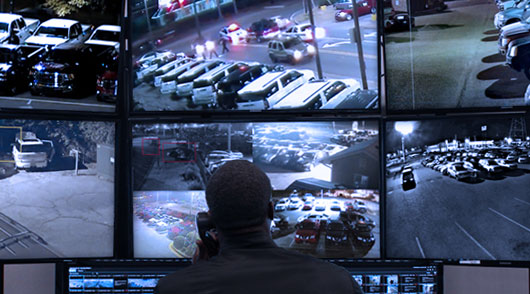
An effective 2026 commercial CCTV system fuses AI analytics that suppress alert noise with behavioral, anomaly, and event-correlation models. Edge inference on GPU/VPU devices delivers low-latency, PTP-synchronized decisions. High-fidelity imaging meets IEC/BS pixel density and WDR ≥120 dB. Cloud-hybrid retention preserves chain-of-custody while optimizing tiers via SLA, RPO/RTO. Zero-trust security enforces mTLS, RBAC, signed firmware, and segmentation. Unified VMS, access, and alarms run SOP-driven workflows with KPI dashboards. Additional practices elevate precision, resilience, and compliance further.
AI-Powered Analytics That Reduce Noise and Surface Action
Although camera density continues to grow, AI-powered video analytics in 2026 focus on reducing alert noise while elevating actionable events through standards-aligned, data-driven methods.
Systems apply rigorous noise filtering to suppress repetitive or low-value triggers, while anomaly detection models baseline normal motion, dwell, and trajectories. Predictive analytics enrich scoring with temporal patterns and zone context to prioritize real-time alerts.
Behavioral analysis classifies interactions—distinguishing loitering, tailgating, or object removal—with calibrated thresholds. Event correlation fuses multi-camera observations and access logs to consolidate duplicates and raise confidence.
Dashboards provide precision metrics for rapid triage and documented incident response. Feedback loops retrain models based on outcomes, improving precision/recall and ensuring alerts align with operational policies and compliance requirements.
Edge Processing for Low Latency and Resilience
Edge processing anchors low-latency, resilient CCTV operations by executing inference, compression, and decision logic on devices compliant with ONVIF, RTSP/RTP, and IEEE 802.1X.
By localizing analytics, systems cut round-trip delay, sustain operations during WAN impairments, and minimize bandwidth without sacrificing fidelity. Hardware accelerators (GPU, VPU, NPU) enhance object detection, tracking, and metadata extraction, while SRTP and TLS secure all streams.
IEEE 1588 PTP ensures sub-millisecond synchronization. Policy engines manage failover, buffering, and adaptation during link degradation. Telemetry—covering utilization, latency, and packet loss—supports closed-loop optimization.
Cloud-Hybrid Storage Strategies for Scale and Control
In 2026, cloud-hybrid storage relies on smart tiering that classifies video by retention class, risk score, and access frequency. On-prem edge retention maintains evidentiary integrity, while cold archives transition to cloud tiers based on SLA and compliance requirements.
Bandwidth-aware replication ensures WAN efficiency without latency breaches.
Smart Tiering Policies
Smart tiering reconciles cost, retention, and performance by programmatically placing assets across on-prem and cloud layers. Policies use metadata such as risk score, retention class, and access frequency to determine storage location.
Lifecycle management, WORM/legal hold, and audit logs ensure traceability. Continuous reclassification adapts to shifting access patterns, maintaining compliance and cost-efficiency.
On-Prem Edge Retention
Edge retention ensures primary copies of video remain near the source, guaranteeing performance and sovereignty. It employs compression, encryption, and indexing standards (H.265/H.266, SRTP, AES-256).
Local NVMe storage handles bursts, while durable nodes ensure immutability. Policies automatically migrate noncritical footage to cloud storage for redundancy and lifecycle management.
Bandwidth-Aware Replication
Replication policies balance performance and bandwidth by prioritizing critical video first and long-term archives later. Adaptive bitrate, chunking, and compression preserve forensic quality while reducing egress.
| Function | Method | Metric |
| Prioritization | Policy tiers, SLA queues | RPO/RTO |
| Throttle | Token bucket, BBR | Mbps ceiling |
| Reduction | Dedup, delta frames | % saved |
| Integrity | Hash trees, immutability | Tamper score |
| Recovery | Multi-region, erasure codes | 11 nines |
Standards alignment: ONVIF, S3 API, TLS 1.3, OAuth2, SRTP.
High-Fidelity Imaging and Intelligent Camera Selection
High-fidelity imaging matches sensor resolution to detail needs and ensures low-light performance through wide dynamic range (≥120 dB). Camera lens types (fixed, varifocal, zoom) and placement geometry must meet IEC/BS pixel density standards.
Resolution and Low-Light Performance
Modern CCTV systems deliver 4K+ resolution, wide dynamic range, and low noise for evidentiary image quality. Back-illuminated CMOS sensors with large pixel pitch preserve clarity under low light.
Compliance with IEC 62676-5 ensures reproducible, audit-ready performance benchmarks.
Lens Type and Placement
- Calculate PPM from sensor, focal length, and distance
- Match FOV to scene geometry
- Control T-stop for motion clarity
- Align optical axis to analytic zones
Tight Integration With Access Control, Alarms, and Operations
Integrating CCTV with access control and alarms creates a unified incident management stack. ONVIF and PSIM integrations allow real-time event correlation and automated actions.
SOAR playbooks reduce response time, while dashboards track linkage accuracy and false-positive suppression.
Zero-Trust Architecture and Cybersecurity Hardening
Modern CCTV environments adopt zero-trust principles—authenticate every device, authorize least privilege, and continuously verify.
Security controls include:
- Mutual TLS and certificate pinning
- Microsegmented VLANs and ACLs
- Just-in-time credentials
- Signed firmware and SBOM validation
- SOAR integrations for automated threat response
Privacy-by-Design and Regulatory Compliance
Privacy-by-design ensures compliance with global data protection regulations. Controls include purpose binding, consent tracking, and immutable audit logs.
| Control Area | Mechanism | Outcome |
| Data Minimization | Selective capture | Reduced exposure |
| Consent & Transparency | Notices, logs | Legitimacy |
| Governance & Audit | Immutable logs | Accountability |
24/7 Remote Monitoring, Health Checks, and Alerting
Continuous system observability ensures uptime, firmware integrity, and compliance. Monitoring validates video quality and security baselines, with SLA-based alert thresholds and automated escalation.
Encrypted remote access, MFA, and API-based integrations guarantee security and operational continuity.
Actionable Dashboards, Reporting, and Workflow Automation
Dashboards turn telemetry into actionable insights. Interactive visualizations enable triage, while reporting pipelines generate evidence logs and KPI trendlines.
Closed-loop feedback continuously improves model accuracy and system responsiveness.
Deployment, Maintenance, and Lifecycle Optimization
Pre-deployment planning, vendor scorecards, and standards alignment (ONVIF, IEC, NIST) ensure scalable, compliant installations.
Lifecycle optimization ties SLAs, firmware roadmaps, and refresh cycles to long-term ROI. Preventive maintenance and KPI-driven governance sustain uptime and performance.
Ready to Modernize Your CCTV System for 2026?
Empower your organization with AI-driven analytics, zero-trust security, and resilient hybrid storage. Don’t let outdated systems compromise visibility or compliance.
Contact our security technology specialists today to design, deploy, and optimize your 2026-ready commercial CCTV system.